Breaking news: Lil Bub, one of the best loved internet cats, will release her debut album Science & Magic on 4 December. According to Andrew WK, who helped create the record with Bub, not only is she the softest creature he has ever encountered, but “also the most musically and compassionately gifted. The songs on this album are her vision. They are by her, about her, and are her.”
Whether you consider it a callous effort to capitalise on one mutant cat’s craze for, or a pioneering step into the outer limits of musical experimentation, the cat album is currently having its moment: take rap duo Run the Jewels, who have released Meow the Jewels, a cat-sound remix of their last album. Or … actually that’s it. Just two albums. But two albums sampling cats in one week is two more than the previous 2015 years have offered up, so worth marking none the less (for the purpose of journalistic integrity, let’s include Mr Mitch and his meow-based track Catford. Which came out in 2013. Three’s a trend).
While the Lil Bub album smacks slightly of a traffic chasing marketing campaign, and Meow the Jewels is a gesture of goodwill (donations to its Kickstarter go to victims of police brutality and neglected animals), previously samples of animals in song have been used for their atmospheric, musical value. The sound of an animal can be symbolic, more evocative or expressive than that of a human’s voice. Take the distant murmurs on Kate Bush’s Moving – 15 seconds of whale song sampled from Songs of the Humpback Whale. In an interview with Sounds, Bush said: “Whales say everything about ‘moving’. It’s huge and beautiful, intelligent, soft inside a tough body.”
It can also be a handy scene-setting device: the nostalgic sound of seagulls squarking through Gruff Rhy’s Shark Ridden Waters, Minnie Riperton’s Lovin’ You – its tweeting birds replicating a bucolic idyll and the first flutters of fancy, or the clip clop and whinny of reindeer on Sleigh Ride by the Ronnettes. No mention of animal sampling symbolism would be complete without the salacious honk of an elephant on Missy Elliott’s Work It.
It’s not always used as a pleasant reminder of mother nature’s creations. Matthew Herbert’s One Pig – an album that documents a pig’s 20-week life, from birth to brutal slaughter – used the samples for a stark look at the meat industry. It’s a terrifying tool for music’s more malevolent, too – the sound of a predator snarling at the start and end of Butthole Surfers’ Mark Says Alright or HateBeak’s Feral Parrot. The world of EDM offers some savage sampling, too – such as Deadmau5’s use of rattlesnakes, or Raff Riley borrowing the sounds of febrile barking dogs.
The sampling of animals can even have its textural qualities, adding layers that an instrument may not – the cooing pigeons on Panda Bear’s Bro’s, or the quiet chatter of birds flitting throughout Radiohead’s The King of Limbs – during the introduction to Give Up the Ghost, the fade out of Codex, and layered under the flugelhorn (yes, flugelhorn) on Bloom.
Friday, 9 October 2015
Sunday, 20 September 2015
Get this: spiders can “sail” on water
If, last week, you’d quizzed me about the dispersal strategies of spiders, I would have told you all about “ballooning”, how Charles Darwin, at sea on the Beagle in 1832, was stunned to see thousands of tiny, dusky red spiders come floating on board, borne on silky parachutes that trapped them in the rigging. This and other observations led him to conclude that “the habit of sailing through the air” was probably “characteristic of this tribe”.
I would not, however, have told you that ballooning spiders can sail on water too, because I didn’t know they did until I read a paper out today in BMC Evolutionary Biology. These sailing skills, documented by Japanese research fellow Morito Hayashi and colleagues, make a lot of sense. Earth, after all, is largely water, so aerial dispersal is not a great idea unless you can cope with the presumably frequent fate of alighting on water.
Working in the “SpiderLab” at the University of Nottingham, Hayashi put hundreds of spiders from more than 20 different species “in a shallow tray filled with water to 1cm height”. When buffeted by “pump-generated air (i.e. wind)”, “spiders actively adopt postures that allow them to use the wind direction to control their journey on water,” he says. They are competent sailors even in salty and turbulent condition, the researchers find.
The paper describes five different water-related behaviours. Here they are:
1) Sailing
Sailing spiders raise their legs to create a kind of sail. “Sailing spiders smoothly and stealthily slide on the water surface without leaving any turbulence,” note Hayashi and co.
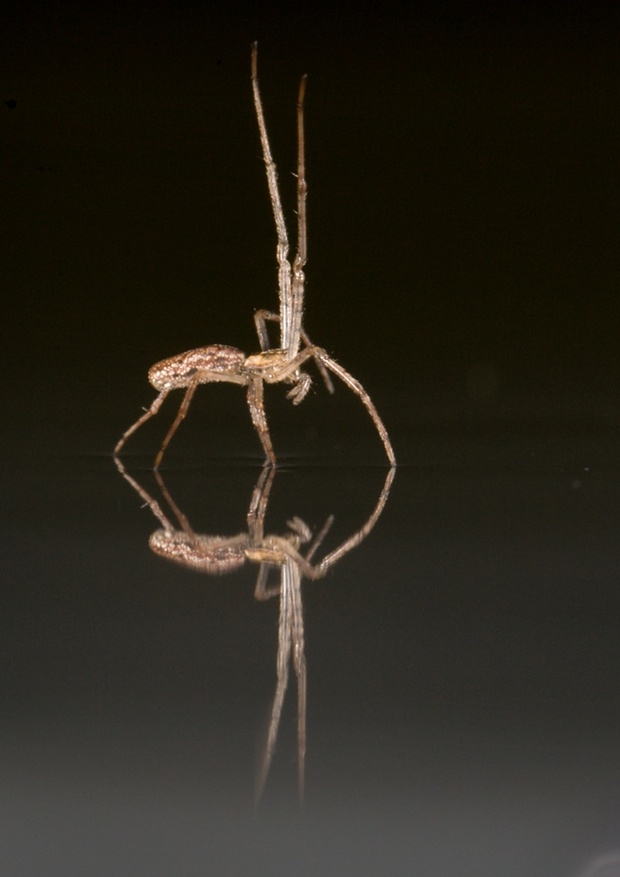
2) Upside-down sailing
This demands a “handstand-like posture”, the spider using its abdomen rather than legs to catch the wind.
3) Anchoring
Silk is released onto the surface of the water. This slows down the spider’s movement and may help tether the spider to the relative safety of a floating object
4) Walking
It’s just that, the spider rapidly propelling its legs in an effort to walk on the surface. [Re-reading Darwin’s account of the dusky red spiders he encountered off the coast of South America, it looks like he observed them walking on water: “The little aeronaut,” he wrote in his Journal of Researches, “could run with facility on the surface of water.”]
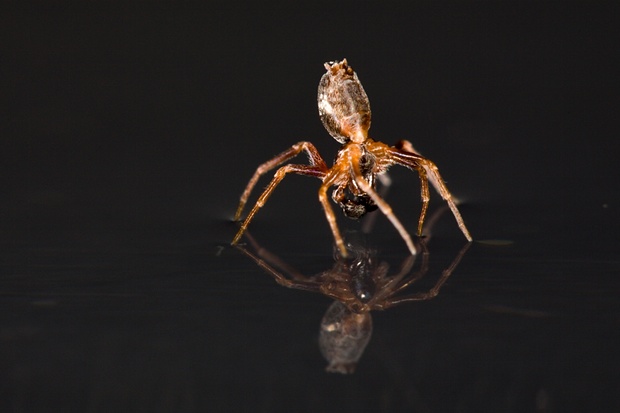
5) Death mimicry
“Death mimicry behaviour is likely to be a predator avoidance strategy, as is common to many animals.” Essentially, the spider touches the water and freezes. But owing to its water-repellent feet (see the dimples on the surface of the water), it still floats.
In a related investigation, the researchers collected data on ballooning. Those individuals and species that showed a readiness to balloon their way off a dry surface were also the ones with the greatest talent for sailing. “The sailing behaviour is almost completely associated with, and possibly a requirement for, the aeronautic behaviour,” they conclude.
“Being able to cope with water effectively ‘joins the dots’ as far as the spider is concerned,” says Sara Goodacre, head of the SpiderLab and a co-author on the paper. “It can move from one land mass to another, and potentially across huge spatial scales through the air,” she says. “If landing on water poses no problem then in a week or two they could be a long way away from where they started.”
Darwin would have loved this, a neat set of observations that helps explain why spiders are amongst the first to colonise new habitats and why many species are found all the way around the globe. They haven’t just been flying. They’ve been sailing too.
I would not, however, have told you that ballooning spiders can sail on water too, because I didn’t know they did until I read a paper out today in BMC Evolutionary Biology. These sailing skills, documented by Japanese research fellow Morito Hayashi and colleagues, make a lot of sense. Earth, after all, is largely water, so aerial dispersal is not a great idea unless you can cope with the presumably frequent fate of alighting on water.
Working in the “SpiderLab” at the University of Nottingham, Hayashi put hundreds of spiders from more than 20 different species “in a shallow tray filled with water to 1cm height”. When buffeted by “pump-generated air (i.e. wind)”, “spiders actively adopt postures that allow them to use the wind direction to control their journey on water,” he says. They are competent sailors even in salty and turbulent condition, the researchers find.
The paper describes five different water-related behaviours. Here they are:
1) Sailing
Sailing spiders raise their legs to create a kind of sail. “Sailing spiders smoothly and stealthily slide on the water surface without leaving any turbulence,” note Hayashi and co.
2) Upside-down sailing
This demands a “handstand-like posture”, the spider using its abdomen rather than legs to catch the wind.
3) Anchoring
Silk is released onto the surface of the water. This slows down the spider’s movement and may help tether the spider to the relative safety of a floating object
4) Walking
It’s just that, the spider rapidly propelling its legs in an effort to walk on the surface. [Re-reading Darwin’s account of the dusky red spiders he encountered off the coast of South America, it looks like he observed them walking on water: “The little aeronaut,” he wrote in his Journal of Researches, “could run with facility on the surface of water.”]
5) Death mimicry
“Death mimicry behaviour is likely to be a predator avoidance strategy, as is common to many animals.” Essentially, the spider touches the water and freezes. But owing to its water-repellent feet (see the dimples on the surface of the water), it still floats.
In a related investigation, the researchers collected data on ballooning. Those individuals and species that showed a readiness to balloon their way off a dry surface were also the ones with the greatest talent for sailing. “The sailing behaviour is almost completely associated with, and possibly a requirement for, the aeronautic behaviour,” they conclude.
“Being able to cope with water effectively ‘joins the dots’ as far as the spider is concerned,” says Sara Goodacre, head of the SpiderLab and a co-author on the paper. “It can move from one land mass to another, and potentially across huge spatial scales through the air,” she says. “If landing on water poses no problem then in a week or two they could be a long way away from where they started.”
Darwin would have loved this, a neat set of observations that helps explain why spiders are amongst the first to colonise new habitats and why many species are found all the way around the globe. They haven’t just been flying. They’ve been sailing too.
Saturday, 5 September 2015
Happy birthday, Jia Jia: Hong Kong giant panda becomes oldest ever
It may not be considered a landmark birthday for humans, but turning 37 has made Hong Kong’s Jia Jia the oldest ever giant panda in captivity, and she celebrated in style.
The equivalent of more than 100 years old in human terms, Jia Jia was presented with a towering birthday cake made from ice and fruit juice with the number 37 carved on top, in her enclosure at the city’s Ocean Park theme park.
“Jia Jia has achieved two Guinness world record titles – the oldest panda living in captivity and the oldest panda ever living in captivity,” said Blythe Ryan Fitzwilliam, adjudicator of Guinness World Records, during a ceremony at the park.
He offered her his congratulations, saying it was an “amazing longevity achievement”.
Jia Jia was born in the wild in Sichuan, China, in 1978 and was given to Hong Kong in 1999 to mark the semi-autonomous city’s handover by Britain two years earlier.
The previous record was held by a male panda called Du Du, who was also caught in the wild and died in July 1999 aged 36 in a zoo in China’s Hubei province.
Vet Paola Martelli said Jia Jia was still “moving about” though she suffered from cataracts and high blood pressure. “She is sleeping more, so is doing everything less. But she is ageing gracefully, just like your grandma,” she said.
Because she eats less bamboo she relies on fibre supplements, Martelli added.
Jia Jia, whose name translates as “excellence”, picked at fruit slices and bamboo around the ice cake to celebrate her big day.
Although the exact birth dates of Du Du and Jia Jia are unknown because they were born in the wild, Guinness said that based on the evidence, they concluded that Jia Jia had claimed the title by a few months.
There are fewer than 2,000 pandas now left in the wild, according to the World Wildlife Fund, as their habitats have been ravaged by development. Roads and railways cut through the bamboo forests they depend upon in China’s Yangtze Basin, their primary habitat. Pandas rely on bamboo and eat almost nothing else.
Given their low birthrate, captive breeding programmes have become key to ensuring their survival.
![]() |
| Jia Jia is said to be still mobile but suffering from high blood pressure. Photograph: Bobby Yip/Reuters |
“Jia Jia has achieved two Guinness world record titles – the oldest panda living in captivity and the oldest panda ever living in captivity,” said Blythe Ryan Fitzwilliam, adjudicator of Guinness World Records, during a ceremony at the park.
He offered her his congratulations, saying it was an “amazing longevity achievement”.
Jia Jia was born in the wild in Sichuan, China, in 1978 and was given to Hong Kong in 1999 to mark the semi-autonomous city’s handover by Britain two years earlier.
The previous record was held by a male panda called Du Du, who was also caught in the wild and died in July 1999 aged 36 in a zoo in China’s Hubei province.
Vet Paola Martelli said Jia Jia was still “moving about” though she suffered from cataracts and high blood pressure. “She is sleeping more, so is doing everything less. But she is ageing gracefully, just like your grandma,” she said.
![]() |
| Jia Jia. Photograph: Bobby Yip/Reuters |
Jia Jia, whose name translates as “excellence”, picked at fruit slices and bamboo around the ice cake to celebrate her big day.
Although the exact birth dates of Du Du and Jia Jia are unknown because they were born in the wild, Guinness said that based on the evidence, they concluded that Jia Jia had claimed the title by a few months.
There are fewer than 2,000 pandas now left in the wild, according to the World Wildlife Fund, as their habitats have been ravaged by development. Roads and railways cut through the bamboo forests they depend upon in China’s Yangtze Basin, their primary habitat. Pandas rely on bamboo and eat almost nothing else.
Given their low birthrate, captive breeding programmes have become key to ensuring their survival.
Wednesday, 19 August 2015
Giant panda pregnancy has Washington zoo director 'cautiously optimistic'
The National Zoo’s giant panda Mei Xiang, who was showing signs of being pregnant, is actually carrying a developing fetus and could give birth in coming weeks, the Washington zoo said on Wednesday.
Veterinarians detected a 1.6in (4cm) fetus during an ultrasound on Wednesday of Mei Xiang, who is a star tourist draw in the US capital, the zoo said in a statement.
“Today, we are cautiously optimistic,” said Dennis Kelly, the zoo’s director.
Veterinarians estimate that Mei Xiang could give birth early next week or possibly in early September, the statement said.
The zoo warned, however, that there is a substantial possibility that the fetus could be miscarried or resorbed, a process in which a fetus is broken down into components and dispersed in the panda’s circulation.
Mei Xiang started showing a secondary rise in her urinary progesterone on 20 July, a sign of pregnancy or a false pregnancy.
Mei Xiang was artificially inseminated on 26 and 27 April. The procedures used frozen sperm from Hui Hui, a panda living in China, and fresh sperm from the National Zoo’s Tian Tian, it said.
Mei Xiang is showing behaviors at the David M Rubenstein Family Giant Panda Habitat in line with pregnancy, such as spending more time in her den, body licking and cradling objects. The inside of the habitat has been closed to the public.
Giant pandas are one of the world’s most endangered species and have a very low reproductive rate, particularly in captivity. Their natural home is in a few mountain ranges in central China. There are about 1,600 giant pandas known to be living in the wild and some 300 in captivity, mostly in China.
![]() |
| Expectant mother giant panda Mei Xiang sleeps indoors at Smithsonian’s National Zoological Park in Washington on Tuesday. Photograph: Michael Reynolds/EPA |
“Today, we are cautiously optimistic,” said Dennis Kelly, the zoo’s director.
Veterinarians estimate that Mei Xiang could give birth early next week or possibly in early September, the statement said.
The zoo warned, however, that there is a substantial possibility that the fetus could be miscarried or resorbed, a process in which a fetus is broken down into components and dispersed in the panda’s circulation.
Mei Xiang started showing a secondary rise in her urinary progesterone on 20 July, a sign of pregnancy or a false pregnancy.
Mei Xiang was artificially inseminated on 26 and 27 April. The procedures used frozen sperm from Hui Hui, a panda living in China, and fresh sperm from the National Zoo’s Tian Tian, it said.
Mei Xiang is showing behaviors at the David M Rubenstein Family Giant Panda Habitat in line with pregnancy, such as spending more time in her den, body licking and cradling objects. The inside of the habitat has been closed to the public.
Giant pandas are one of the world’s most endangered species and have a very low reproductive rate, particularly in captivity. Their natural home is in a few mountain ranges in central China. There are about 1,600 giant pandas known to be living in the wild and some 300 in captivity, mostly in China.
Tuesday, 14 July 2015
Caring for Rabbits
![]() |
| Caring for Rabbits |
Dealers and “pet” stores usually request 4-week-old bunnies because they require less space and are “cuter,” but bunnies of this age are ill-prepared to be weaned from their parents. Many people who purchase these young, small bunnies do not realize that depending on breed, the average weight for an adult rabbit is anywhere from 2 to 20 pounds.
Rabbits are social creatures with gentle natures and individual personalities, and they need just as much attention as a dog or cat. They are not suitable companions for young children. Rabbits require specific foods, stimulating environments, and veterinarians who have specialized knowledge of their species.
How to Spot Neglect
Federal regulations apply only to those breeders or “bunny mills” that do at least $500 of business with a particular pet store, and enforcement is lax, so the rabbits that you see in the store may not have been properly transported or cared for.
A runny nose, sneezing, head-tilt, listlessness, and diarrhea are all signs of a sick bunny. Rabbits have extremely delicate respiratory and digestive systems, and any change in the balance of these systems can result in death if they are not treated properly and quickly. Bare spots or scabs anywhere on the body suggest that the rabbit has parasites or has been fighting with other rabbits.
Adoption
If—after careful consideration—you have decided to welcome a rabbit into your home, please adopt from your local humane society or rabbit rescue group. Rabbits can live up to 10 years and require annual checkups by a veterinarian who is familiar with rabbits. Bunnies need lots of company and can become withdrawn and depressed if not provided with plenty of love and companionship. Rabbits do get along with dogs and cats if they are all safely socialized.
If you plan to adopt two rabbits, consider a neutered male and a spayed female, as they are usually more compatible than two fixed same-sex bunnies. It is crucial to have your new companion spayed or neutered immediately. Otherwise, males mark their territory, females run a high risk of uterine cancer, and the already serious overpopulation crisis becomes worse.
Rabbit-Proofing
Rabbits cannot tolerate extreme heat and must be provided with shelter from the cold. They prefer to live indoors, where they can participate in their caretaker’s everyday life, but before you let your new friend into your home, there are a few things you need to do to ensure his or her safety and happiness. Bunnies are natural chewers and they love to play, so be sure to provide plenty of toys. Untreated wood; straw; wire cat-balls; keys; paper towel rolls; and hard, plastic baby toys work well, but even with all these fun toys to play with, bunnies are drawn to electrical and phone wires, books, baseboard molding, door jams, and plants.
You’ll need to cover or redirect wires and move the rest of these items up and out of the way before bringing your bunny home. You’ll also want to set up a large box or basket filled with shredded paper for your new companion to dig in. Not all rabbits are chronic diggers, but those who are will take their natural digging instincts out on your rugs and other furnishings unless you’ve supplied an alternate digging spot. And while you’re setting up, don’t forget that rabbits also need a safe, quiet haven such as a cardboard box or plastic carrier with a towel inside. Wire cages are not suitable for bunnies.
Litter Training
Litter training is possible at any age—since rabbits like to relieve themselves in one place—and older rabbits tend to be quicker students than youngsters. Even if you plan on giving the bunny the run of the house, you’ll need to conduct litter training in a relatively confined space. Fill a litterbox with paper pulp litter. Do not use clay, as it is deadly for rabbits’ delicate digestive systems! Place the litter box in the corner of the cage or room. Try encouraging your rabbit by putting some of his or her droppings into the box or try using timothy hay or treats. Rabbits learn easily, and before long, you will be able to leave litterboxes in different locations around the house.
“We’re Vegetarians, Thank You!”
The bulk of a rabbit’s diet should be grass, timothy or oat hay, and fresh vegetables. You may also try giving a limited amount of pellets and a small amount of fruit to him or her. Dark leafy greens, broccoli, carrots, parsley, watercress, bananas, apples, pears, and pineapples are all good choices. Stay away from iceberg lettuce (too much water) or large amounts of cabbage (can give a bunny gas). Like dogs or cats, rabbits may be prone to begging at the table. As tempting as it may be to give your rabbit a taste of whatever it is that you’re eating, rabbits have digestive systems that are easily disrupted, so you should stick to his or her normal diet. Check with your vet before you add other treats.
Grooming and Handling
Although rabbits clean themselves much as cats do, rabbits do not have the ability to cough up hairballs, so it is imperative that you groom your rabbit a least once a week. Most rabbits love the attention and grooming prevents digestive problems later in life
Rabbits are instinctively nervous when lifted off the ground. Because of the delicate structure of their spines and the power of their leg muscles, struggling rabbits can actually break their own backbones. Never lift a rabbit by the ears or with just one hand under the stomach. Rabbits do not like to be carried around as cats or dogs might. It is best to get down on their level to interact with them, but if you must pick your rabbit up, make sure that you are supporting his or her hind legs and rump at all times and using your other hand to support his or her chest. Once acclimated to your home, bunnies will come to you, jump into your lap, and even sleep with you.
Subscribe to:
Posts (Atom)