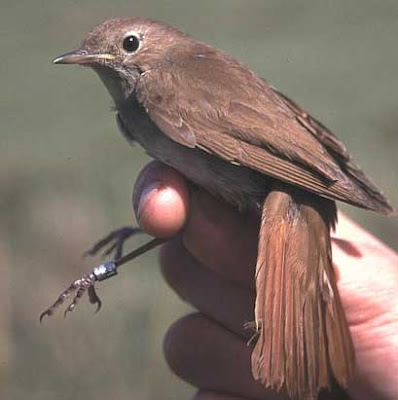
Apart from its habitat, dietary habits, temperament and life span, you
might not know much about a nightingale. In fact, there are a few facts about
them that you might not have heard about:
* The term nightingale stands for "night songstress". According to this,
one might assume that it is the female bird that sings. However, in reality, it
is the opposite. The high-pitched melodious voice is actually of the male.
* At the time of when the egg hatches, a male nightingale will stop
singing. It does this in order to avoid gaining any attention towards itself and
its kids. However, it may whisper little chirps to the female to let it know of
their safety or any potential danger.
* It is very difficult to differentiate a male
nightingale from a female.
This is because the differences in between them are too slight to be noticeable.
The male has slightly a yellowish, brown upper part, goes reddish near the head,
and goes even darker around the main feathers. As for the lower part, it has a
gray-white streak which extends till the tail. The female, on the other hand, is
a little smaller in size. However, it has the same colors of the feathers.
Moreover, it does not stand as straight as the male, and has smaller eyes than
the male.
They are a road map that point you in the right direction. Each message is
filled with instruction, right down to the very last detail, providing you with
insights and ways on how to escape from your current state of misery.
You can change all this if you decide to visit the Cotswold Water Park for
a Cotswold break towards the end of April. On Wednesday 28th April there will be
a special event in the park which will bring you closer to the lesser spotted
nightingale.
The event is called the Nightingale Symphony, which should go a long way
towards telling you what to expect on the night. The event starts at half past
seven in the evening, so you will have all day to enjoy the delights of the
Cotswolds before going along to enjoy this event. The Cotswold Water Park
website states that advance booking is necessary, since only a small number of
people will be able to attend. This makes sense as too many people could
frighten the birds off and make it impossible to hear them sing.
The nightingale is slightly larger than the European Robin, at 15–16.5 cm
(5.9–6.5 in) length. It is plain brown above except for the reddish tail. It is
buff to white below. Sexes are similar. The eastern subspecies L. m. hafizi and
L. m. africana have paler upperparts and a stronger face-pattern, including a
pale supercilium.
Nightingales are named so because they frequently sing at night as well as
during the day. The name has been used for well over 1,000 years, being highly
recognizable even in its Anglo-Saxon form – 'nightingale'. It means 'night
songstress'. Early writers assumed the female sang when it is in fact the male.
The song is loud, with an impressive range of whistles, trills and gurgles. Its
song is particularly noticeable at night because few other birds are singing.
This is why its name includes "night" in several languages. Only unpaired males
sing regularly at night, and nocturnal song is likely to serve to attract a
mate. Singing at dawn, during the hour before sunrise, is assumed to be
important in defending the bird's territory. Nightingales sing even more loudly
in urban or near-urban environments, in order to overcome the background noise.
The most characteristic feature of the song is a loud whistling crescendo,
absent from the song of Thrush Nightingale. It has a frog-like alarm call.
During the Romantic era the bird's symbolism changed once more: poets
viewed the nightingale not only as a poet in his own right, but as “master of a
superior art that could inspire the human poet”. For some romantic poets, the
nightingale even began to take on qualities of the muse. Coleridge and
Wordsworth saw the nightingale more as an instance of natural poetic creation:
the nightingale became a voice of nature. John Keats' "Ode to a Nightingale"
pictures the nightingale as an idealized poet who has achieved the poetry that
Keats longs to write. Invoking a similar conception of the nightingale, Shelley
wrote in his “A Defense of Poetry".
"A poet is a nightingale who sits in darkness and sings to cheer its own
solitude with sweet sounds; his auditors are as men entranced by the melody of
an unseen musician, who feel that they are moved and softened, yet know not
whence or why."